institute of europe
the institute of europe of the russian academy of sciences
74th meeting of Shmelev Economic Seminar
- 10 November 2026
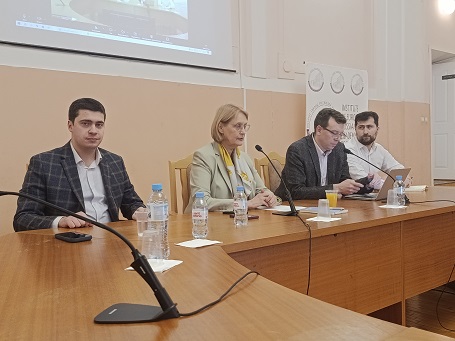
November 10, 2026, 74th meeting of Shmelev Economic Seminar was dedicated to 2026 Nobel Prize in Economic Sciences.
Title: How Microfoundations Shaped Modern Economics and EU Policy?
Moderator: Olga Butorina, Deputy Director, Institute of Europe, Russian Academy of Sciences (IE RAS).
Speakers: Alexander Maltsev, Head of Political Economy Department, Lomonosov Moscow State University (MSU). Alexander Vashilchenko, Researcher (IE RAS).
In his keynote address, “From Kondratiev to Woodford: The Evolution of Views on Economic Cycles and Macroeconomic Policy,” Professor Alexander Maltsev traced the evolution of economic thought from viewing business cycles as statistically regular and, hence, potentially predictable phenomena to interpreting economic fluctuations as fundamentally stochastic processes. Particular attention was given to the factors underlying the shift in the dominant analytical paradigm towards the study of random shocks, expectations, and microeconomic foundations. The speaker stressed, however, that the emergence of a stochastic perspective on economic dynamics does not entail the wholesale displacement of alternative theoretical approaches. Rather, it represents a reassessment of the scope and applicability of different models, highlighting the continued coexistence of complementary analytical frameworks, each suited to addressing distinct research questions and forecasting horizons.
Alexander Vasilchenko’s contribution, entitled “EU Macroeconomic Policy in the Face of Contemporary Foreign Economic Shocks”, focused on the contributions of Nobel laureates Robert Hall and Michael Woodford to macroeconomic stabilization theory and explored the relevance of their insights for contemporary EU policymaking. The empirical analysis focused on the relationship between household financial expectations and actual consumption patterns. The speaker identified three principal transmission channels through which external economic shocks affect national economies: price channel, physical supply channel and technological channel. He further highlighted the heterogeneity of these effects across EU member states, attributing it to differences in economic structures and degrees of external dependence.